How to Price Photo Booth Rental Packages: Formula, Worked Example and Break-Even
Price your photo booth rentals for profit: fixed vs variable costs, a minimum-price formula, tiered packages, add-ons and a simple break-even calculation.
Also available in: Bahasa Indonesia · 中文
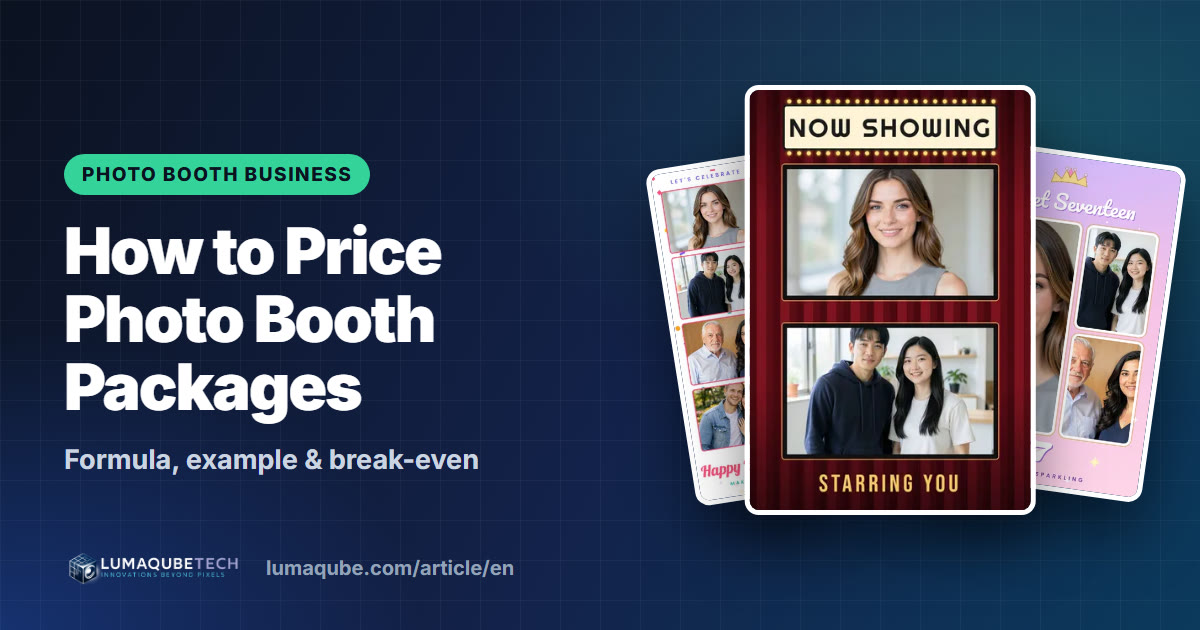
Pricing is where many new photo booth businesses go wrong. Price too low and you work every weekend for very little. Price too high without a clear reason and inquiries go to the next vendor. This guide shows how to price photo booth rental packages step by step: what goes in a package, fixed versus variable costs, a minimum-price formula with a worked example, tiered packages, add-ons and a simple break-even calculation.
All dollar amounts below are illustrations. Equipment, media, labour and market rates vary widely between cities and countries, and the same logic works in euros or pounds. Plug in your own numbers.
What goes into a photo booth rental package?
Before you set a price, define exactly what you're selling. Typical components:
- Rental time: usually 2, 3 or 4 hours of operation. Setup and breakdown come on top.
- Prints: unlimited during the rental (what most clients want), a fixed number, or one print per session.
- Print format: 4×6 photos or the classic 2×6 strip. Strips are often printed in pairs, one for the guest and one for the host's scrapbook.
- Custom print design with names, date, logo or event theme. A big part of the perceived value.
- Backdrop: standard (solid, sequin) or premium (flower wall, branded backdrop, digital backgrounds with no green screen).
- Props and an attendant who guides guests and keeps the line moving.
- Digital delivery: QR codes for instant downloads, an online gallery, and all files for the host afterwards.
Add-ons raise the average order: a guest-book scrapbook, GIFs and boomerangs, a 360 video booth, AI portraits, branded props, data capture for brands, or extra hours.
Know your fixed and variable costs
Healthy prices start with honest costs. Split them into two groups:
| Cost type | What it means | Examples |
|---|---|---|
| Fixed costs | Paid every month whether you have events or not | Insurance, equipment financing, software and cloud subscriptions, marketing and listings, website and phone, storage |
| Variable costs | Incurred for each event | Print media, attendant wages, fuel, tolls and parking, consumable props |
Don't forget depreciation. Cameras, printers and laptops wear out, so setting aside part of every booking for replacements is a real cost.

The minimum-price formula
Once your costs are listed, use this simple formula:
Worked example
Say you're pricing a 3-hour package with unlimited 2×6 strips:
| Item | Calculation | Amount |
|---|---|---|
| Print media | about 150 sheets × $0.30 | $45 |
| Attendant | 4 hours incl. setup × $25 | $100 |
| Fuel, tolls, parking | $40 | |
| Consumable props | $15 | |
| Variable costs per event | $200 | |
| Fixed costs per event | $600 a month ÷ 4 events | $150 |
| Target profit | $400 | |
| Minimum price | $750 |
So in this example, $750 is the floor for that package. If local rates are well below it, cut costs or add value that justifies your price. Don't simply match the cheapest listing.
Build tiered packages: Basic, Standard, Premium
Three tiers make choosing easy and give you room to upsell. Most clients pick the middle option.
| Package | For | Example contents |
|---|---|---|
| Basic | Small parties, tight budgets | 2 hours, standard backdrop, digital delivery plus a limited number of prints, template designs |
| Standard | Most weddings and parties | 3 hours, unlimited prints, custom print design, choice of backdrops, attendant, QR downloads and online gallery |
| Premium | Clients who want the full experience | 4+ hours, premium backdrop, themed props, guest-book scrapbook, GIF/boomerang or AI portraits, all files delivered |

Sell value, not the lowest price
Competitor research tells you the range. It shouldn't set your price on its own. You can charge more when you deliver more:
- Fast, sharp, smudge-proof dye-sub prints.
- Print designs made for each event, not generic templates.
- A friendly, professional attendant who keeps the energy up.
- Features few local vendors offer, like AI portraits, face swap or a 360 booth.
- Reliability: on time, insured, tidy setup, files delivered when promised.
Keep a little room to negotiate for corporate clients, multi-service bookings or off-peak dates, but never go below your minimum price.
Break-even: when does your investment pay back?
Besides the price per event, you'll want to know when your startup investment comes back:
Break-even (months) = events needed ÷ average events per month
Two event-booth scenarios:
| Lean start | Professional setup | |
|---|---|---|
| Equipment | Used camera, compact dye-sub printer, used laptop, LED light, software, backdrop and props | New camera, high-capacity dye-sub printer, laptop, two strobes, booth enclosure, software, several backdrops |
| Total investment | $4,500 | $12,000 |
| Package price | $650 | $1,100 |
| Variable costs | $180 | $250 |
| Profit per event | $470 | $850 |
| Break-even | about 10 events | about 14–15 events |
| At 3–4 events a month | about 3–4 months (3 a month) | about 3–4 months (4 a month) |
A self-portrait studio needs more capital (lease deposit, build-out, decor, furniture) and carries rent and wages every month. Work it out on monthly net profit: for example, $60,000 invested and $5,000 net profit a month pays back in about 12 months.
The first months are usually slower until you have reviews and referrals. Keep a cash reserve for repairs and price increases, and review your numbers every month.
Deposits, contracts and cash flow
- Take a retainer at booking, commonly a quarter to half of the total, to hold the date. Say in the contract whether it's refundable.
- Set a balance due date, for example 7 to 14 days before the event.
- Use a written contract covering the package, hours, date and venue, price and payment schedule, cancellation and rescheduling, what the client provides (space, power, access), overtime rates, and force majeure.
- Charge tax correctly: sales tax in the US depends on your state; VAT applies in Europe above local thresholds. Ask an accountant.
- Keep business money separate and record every income and expense from day one.
Frequently asked questions
How much should I charge for a photo booth rental?
There's no single right number; rates vary a lot by city and by what's included. Calculate your minimum price with the formula above, compare with competitors offering similar packages, and position yourself on the value you deliver.
Should I offer unlimited prints?
Unlimited prints are easy to sell and clients expect them at weddings. To stay profitable, track how many prints you average per hour and include that in your variable costs. Limited-print packages suit small parties and tight budgets.
Should I show prices on my website?
"Packages from…" pricing filters out poor fits and speeds up conversations. Send detailed quotes once you know the event's date, hours and needs.
Ready to run your own photo booth?
Q-Booth runs photo, collage, video and AI photo booths from one Windows app. Try it free before you buy.
Learn Q-Booth
Step-by-step guides and video tutorials for every kind of booth.